
- By Best Solar Company PK
- 18 Sep, 2026
- Solar Policy
- 8 min read
For millions of Pakistani families squeezed by rising tariffs, the **PM Roshan Ghar Initiative** is one of the most important energy announcements of 2026. The federal scheme puts subsidized rooftop solar within reach of the country's lowest-consuming "protected" and lifeline households — the very people who have been priced out of solar until now. If your home draws 200 units a month or less, this programme was designed for you.
At Best Solar Company PK, we field questions about the **PM Roshan Ghar solar scheme** every single day. This guide cuts through the confusion: who qualifies, what you actually receive, how ESCO-licensed installers and DFI financing fit together, and the step-by-step way to apply in 2026.
What is the PM Roshan Ghar Initiative?
The PM Roshan Ghar Initiative is a federal rooftop-solar programme that channels government subsidy, development finance institution (DFI) lending, and vetted installation into one package for low-income domestic consumers. Instead of handing out cash, the state lowers the upfront cost of a small solar system and lets approved installers deliver and connect it.
The initiative builds directly on the federal **Free Solar Panel Scheme for 0–200 unit consumers**, which carried a financial outlay of roughly **Rs. 9.97 billion** and targeted around **100,000 beneficiary households** with a sanctioned load of up to 2 kW. Roshan Ghar widens that footprint by adding financing so families can step up to a slightly larger system where their roof and budget allow.
The goal is simple: turn a lifeline electricity consumer into a self-generating household — cutting the bill without adding a debt they cannot service.
Three pillars make it work:
- **Government subsidy** that reduces the sticker price of the panels and inverter.
- **ESCO-licensed installers** — Energy Service Companies vetted and licensed to design, supply, and safely connect each system.
- **DFI financing** through partner banks so the remaining cost is spread over easy monthly instalments.
Who qualifies for the Roshan Ghar solar subsidy?
Eligibility is deliberately tight so the benefit reaches genuinely deserving homes. You are likely to qualify if you meet these conditions:
- You are a **domestic (residential) electricity consumer**, not commercial or industrial.
- Your average monthly consumption is **0–200 units (kWh)**, placing you in the protected/lifeline category on your DISCO bill.
- Your **sanctioned load is small** — typically up to 2 kW for the base subsidy tier.
- You hold a **valid connection in your own name** (or can provide the owner's consent) with a recent, unpaid-free billing history.
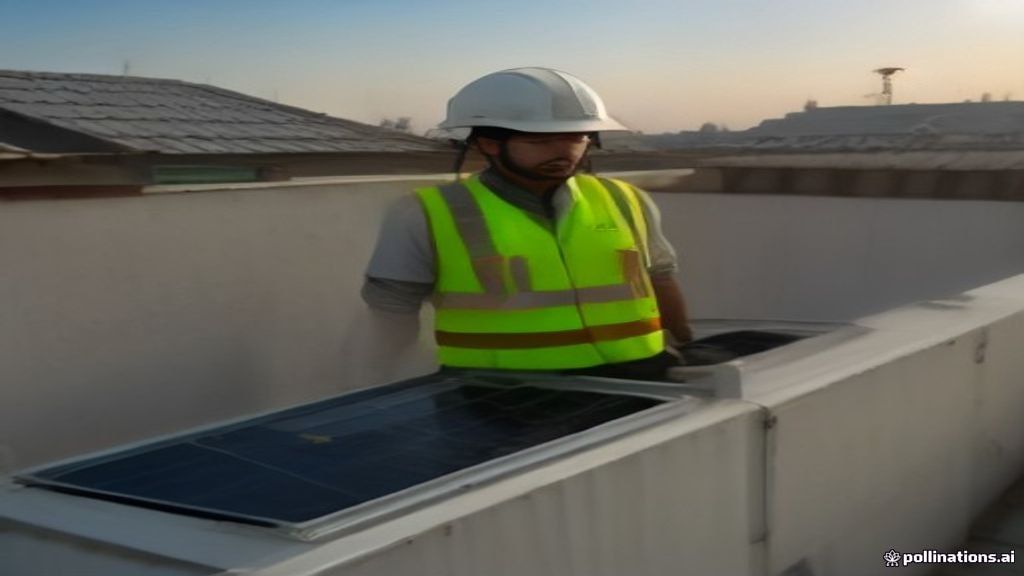
- You have a **usable rooftop** — a shade-free area of roughly 150–250 sq. ft. for a 1–2 kW array.
Check your last bill. If the tariff slab shows you as a "protected" consumer and your 12-month average sits at or below 200 units, you are in the target group. Households that regularly cross 200 units fall outside the subsidised tier, though they can still finance a system commercially.
What do you actually get?
A typical Roshan Ghar package for a protected household looks like this:
| Component | Typical spec (1–2 kW) | Indicative value (PKR) | |---|---|---| | Solar panels | 2–4 × N-type modules | 90,000 – 180,000 | | Inverter | 1–2 kW hybrid/on-grid | 45,000 – 110,000 | | Mounting + cabling | Galvanised structure, DC/AC wiring | 25,000 – 45,000 | | Installation + net-billing setup | ESCO labour + connection | 20,000 – 40,000 | | **Estimated system total** | **1–2 kW grid-tied** | **180,000 – 375,000** |
The subsidy and DFI loan together bring the effective monthly outlay for a qualifying family down to a level often **comparable to their old electricity bill** — which is the whole point. A well-sited 1–2 kW system can generate 120–260 units a month, enough to cover fans, lights, a refrigerator, and daytime appliances for a modest home.
How net billing changes the maths in 2026
Timing matters. Under the **NEPRA (Prosumer) Regulations, 2026**, Pakistan has shifted new rooftop systems from the old one-to-one *net metering* to a *net billing* arrangement, effective **9 February 2026**. Instead of swapping units at full retail value, surplus power you export is credited at a nationally determined average purchase price — set around **Rs. 13 per unit** after industry consultation, down from the earlier ~Rs. 22.
What this means for Roshan Ghar applicants:
- **Self-consumption is now king.** Every unit you use *directly* offsets a retail-tariff unit (Rs. 45–60+), which is far more valuable than exporting.
- **Right-size your system.** For a 0–200 unit home, a 1–2 kW array sized to daytime use beats an oversized system that dumps cheap surplus to the grid.
- **Agreement terms are shorter** — the standard prosumer term moved from 7 years toward 5 — so plan your payback around self-use, not export income.
Our engineers now design protected-household systems for **maximum daytime self-consumption**, which keeps the savings strong even under net billing. For a deeper breakdown, see our guide to net billing vs net metering in Pakistan.
How to apply: step by step
1. **Confirm your category.** Pull out your latest DISCO bill and verify the "protected" status and your 0–200 unit average. 2. **Register on the official portal.** Applications are processed through the federal/provincial scheme portal (Punjab runs a parallel *Roshan Gharana* window at energy.punjab.gov.pk). Enter your reference number, CNIC, and contact details. 3. **Await balloting/verification.** Because demand exceeds slots, beneficiaries are selected via **transparent computerised balloting** and **physical verification** by the district administration. 4. **Choose an ESCO-licensed installer.** Once approved, pick a vetted installer to survey your roof and finalise the system size. 5. **Arrange DFI financing.** Complete the loan form with a partner bank — schemes such as **NBP Roshan Ghar Solar Finance** offer amounts from **PKR 400,000 to 5,000,000** over terms up to **7 years**, and SBP-refinanced solar loans can price around **7–10%**. 6. **Install and connect.** Your ESCO installs the system and files the net-billing application with your DISCO.
Keep your CNIC, recent bills, proof of income, and property/ownership documents ready — they are required at both the balloting and financing stages. If you want help sizing a system before you apply, our team offers a free solar load assessment.
Frequently Asked Questions
**Is the PM Roshan Ghar Initiative completely free?** No. It is *subsidised*, not free in most tiers. The government reduces the price and DFI financing covers the balance in instalments. Some provincial variants (like Punjab's Roshan Gharana balloting) do award fully funded 1–2 kW systems to selected 0–200 unit winners — but seats are limited and awarded by draw.
**I use 250 units a month. Can I still qualify?** Not for the protected-household subsidy, which caps at 200 units. However, you can still install a financed grid-tied system commercially and benefit from net billing and SBP-backed solar loans.
**Does net billing make solar less worthwhile in 2026?** It lowers the value of *exported* surplus, not of the power you use yourself. For a small protected-household system sized to daytime consumption, savings remain strong because you avoid buying expensive grid units.
**Which installers can I trust under the scheme?** Only **ESCO-licensed installers** — Energy Service Companies vetted for this programme. Always confirm licensing before signing. You can verify solar equipment standards and approved-vendor guidance via the Alternative Energy Development Board (AEDB).
**How long does approval take?** It varies by DISCO and balloting cycle, but expect a few weeks from registration to verification, then 1–3 weeks for installation and net-billing connection once financing clears.
The bottom line
The PM Roshan Ghar Initiative is a genuine chance for Pakistan's protected and lifeline households to escape the tariff trap — provided you apply correctly and size the system for self-use under the 2026 net-billing rules. Confirm your 0–200 unit status, register early, insist on an ESCO-licensed installer, and let DFI financing do the heavy lifting.
Ready to check your eligibility and get an honest system quote? Talk to Best Solar Company PK — we'll assess your roof, your bill, and the fastest route to approval.
---
**Sources:** Punjab Free Solar Panel Scheme (0–200 Units) · NEPRA Prosumer / net-billing rules 2026 (pv magazine) · NBP Roshan Ghar Solar Finance FAQs · Nepra shift to gross/net billing (Profit)
Best Solar Company PK designs and installs reliable solar systems in Rawalpindi, Islamabad, Lahore, Multan, Taunsa Sharif and Karachi. Contact us for a free survey and the best advice for your home or business.